
Margery and Me
COMING APRIL 21, 2026!
In the 1920s famous psychic Margery Crandon astounds her followers and confounds scientists and magician Harry Houdini. Will Houdini be her undoing?
At a time when spiritualism draws many wishing to commune with their dearly departed, medium Margery Crandon entertains Boston society and intrigues psychic researchers. Her deceased brother, Walter, regularly visits her seances, regaling the circle with his salty repartee. She attracts followers like Sir Arthur Conan Doyle and William Butler Yeats, but Harry Houdini insists she’s a fraud. Will the master magician undo her, or will her powers convert him? Margery and Me is based on the true story of the medium who created a sensation in America and Europe.
View the book trailer.
Praise for Margery and Me
“In 19th century Boston, socialite Mina Crandon, a charming young wife and ambitious clairvoyant, has accidentally summoned her dead brother Walter to a séance. Walter is a talker and once he’s got an audience, he’s on a mission to make his sister rich and famous. In this highly enjoyable excursion among the spookists,the term “ghostwriter” gets a breathtaking workout. Margery and Me is a wry, lively, and wicked-good novel.”
—Valerie Martin, Winner of the Kafka and Britain's Women's Prizes, author of The Ghost of the Mary Celeste
“Set during the height of America’s spiritualist movement, this rollicking account of the inimitable psychic Margery Crandon—aka Houdini’s greatest nemesis—is filled with colorful characters and clever wit. I had a blast reading Margery and Me and so will you!”
—Kris Waldherr, author of The Lost History of Dreams and Unnatural Creatures
“The ghost of a young railway man in 1923 turns up both in his beloved sister Margery’s life and at her seances, hoping to guide her in her new vocation as a medium. At first a playful delight, the novel turns dark as experts across America relentlessly try to prove that she is a fake. But Margery is human and often fails to heed her ghostly brother Walter’s good advice when he finds it “damned frustrating watching helplessly from the beyond.” An unusually captivating, original, and witty novel of a good-hearted spirit set down on earth to remedy the problems of a sister he loved very much and left too early.”
—Stephanie Cowell, American Book Award winner and author of Claude and Camille, The Boy in the Rain, and The Man in the Stone Cottage
"Margery and Me is based on the true story of an American psychic who drew both the admiration of Sir Arthur Conan Doyle and the skepticism of Harry Houdini. True to the parlors of both the modest and the great in which Margery performed her feats, Biaggio’s novel is a fast-paced, historically rich account of the spiritualist’s struggles to have her psychic powers accepted and celebrated. Narrated by her dead brother Walter, a gleeful storyteller who performs stunts as entertaining as his voice, the novel depicts the many experiments Margery endures at the hands of the powerful men associated with the journal Scientific American. A spiritualist narrative about a pre-feminist society that harshly scrutinized strong women, Margery and Me is a delightful story about the power of vision and purpose, especially when that purpose is greater than oneself.”
—Laura Hulthen Thomas, author of The Meaning of Fear
“Margery and Me is a spellbinding dive into the glittering yet shadowy world of 1920s spiritualism and the enigmatic life of Margery, the era’s most notorious psychic. With meticulous historical detail, this novel brings to life the electrifying world of flapper-era Boston, where the lines between science and superstition are blurred and séances captivate both the curious and the skeptical. Both entertaining and heartbreaking, Margery and Me is a masterfully told story of ambition, love, and the haunting cost of chasing the beyond. I will think about this novel for a long time.”
—Victoria Kelly, critically-acclaimed author of Mrs. Houdini and Homefront
Houdini's Quest to Debunk the Most Famous Medium of the 1920s
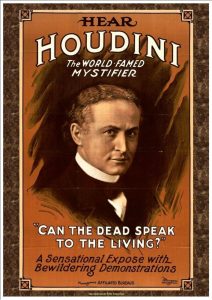 When people think of Harry Houdini, they usually picture the world’s greatest escape artist: a man wriggling free from straitjackets, submerged water tanks, and locked chains. But in the final decade of his life, Houdini took on an altogether different challenge—one that blurred the line between entertainment, ethics, and cultural combat. He waged war on mediums.
In the late nineteenth and early twentieth centuries, the belief that the living could communicate with the dead through mediums gained extraordinary traction. World War I and the 1918 influenza pandemic left millions grieving. The war claimed the lives of some 20 million soldiers, and influenza took at least 50 million lives. In both cases, most victims were young—between 20 and 40 in the case of the flu—and left behind parents, spouses, sweethearts, and children. Séances, Ouija boards, and spirit photography offered solace in a time of mass death. Spiritualism was not a fringe belief: It attracted millions of adherents and found champions among scientists, writers, and social elites.
Houdini himself was initially sympathetic. The death of his beloved mother in 1913 devastated him, and he attended séances hoping to connect with her spirit. But the results were disillusioning. Mediums claimed messages from beyond, yet none conveyed anything his mother would plausibly say. Houdini began to suspect that what passed for spiritual communication was something else entirely.
As a professional magician, Houdini possessed a rare advantage when it came to examining the techniques mediums employed. He understood how illusions worked—how sound could be thrown, objects manipulated unseen, and darkness exploited. What others interpreted as supernatural phenomena looked, to him, like stagecraft.
By the early 1920s, Houdini’s skepticism hardened into a moral crusade. Spiritualism was booming, and professional mediums charged high fees for séances, promising reunion with lost loved ones. Houdini increasingly saw this not as a harmless belief but as an exploitation of grief.
Rather than quietly dismiss spiritualism, Houdini chose confrontation. He began attending séances in disguise, carefully observing the mechanics of tables, cabinets, and ectoplasm manifestations.
Houdini capitalized on the controversy over spiritualism by turning exposé into performance. On lecture tours across the United States and Europe, he demonstrated how mediums could produce spirit writing, levitate objects, and project ghostly voices—then explained the techniques in detail. His shows blended education and entertainment, but the message was uncompromising: These phenomena required no spirits, only skill and deception.
Houdini’s most famous detractor was Sir Arthur Conan Doyle, creator of Sherlock Holmes and an ardent believer in spiritualism. Once friends, the two men fell into an increasingly public and acrimonious feud. Doyle believed Houdini possessed genuine supernatural powers that he refused to acknowledge; Houdini believed Doyle had been tragically duped.
Their disagreements spilled into newspapers, lectures, and books, becoming emblematic of a broader cultural divide between skepticism and belief. For Houdini, the feud underscored what he saw as spiritualism’s danger: Even brilliant minds could be misled when emotion overrode evidence.
Houdini’s campaign reached national prominence through his involvement with Scientific American, which in 1922 offered a $2,500 prize to any medium who could demonstrate genuine paranormal ability under controlled conditions. And that’s where the subject of my latest novel, Margery Crandon, comes in. Margery’s husband, a respected surgeon in Boston, entered Margery in the contest, and what ensued was a great battle between Margery and Harry Houdini, one of the members of the Scientific American prize committee. All the scientists on the committee thought Margery was a genuine psychic, but Houdini insisted she was a fraud. The story of her quest for the prize and Houdini’s attempts to undo her created a sensation in America and Europe. And their contest proved an irresistible subject for this novelist!